Cybersecurity
AI-assisted hacking operation harvested thousands of credentials in under six hours
Google and Mandiant documented how a compromised cloud environment became a platform for fast, coordinated credential theft. The case shows how autonomous tools are shortening defenders’ response windows.
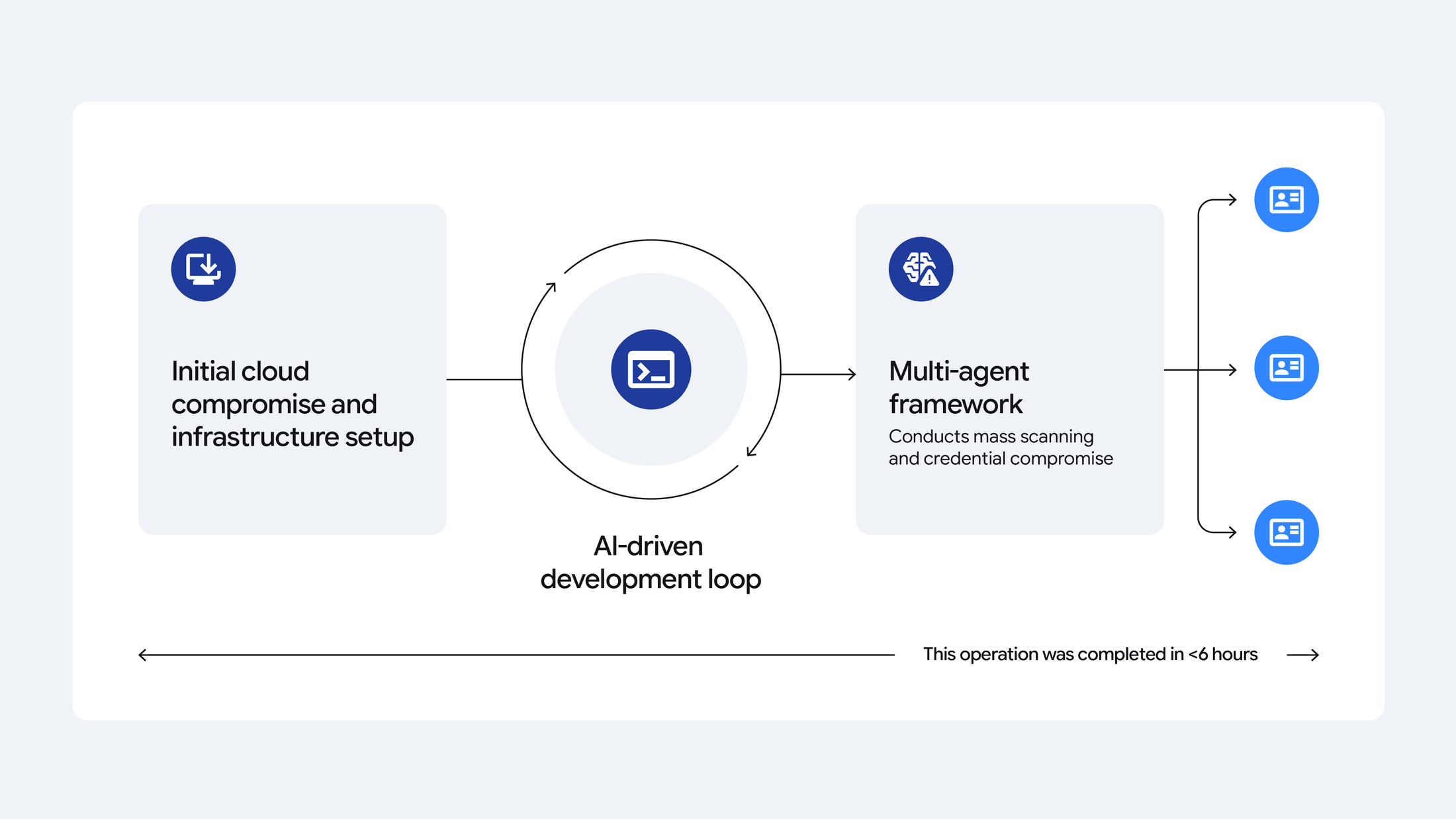
Kuva: Google Threat Intelligence Group / Mandiant. Tutkimusraportin kaavio tekoälyavusteisesta tunnusten keruusta.
A COMPROMISED CLOUD ENVIRONMENT BECOMES AN ATTACK PLATFORM
Google Threat Intelligence Group reported in September 2026 that an apparently financially motivated actor used a compromised cloud environment to collect thousands of third-party credentials. According to the investigators, the campaign’s planning, tool development and execution took less than six hours.
The striking feature was not a new type of vulnerability. The attacker connected an AI coding assistant to a system of task-specific agents and configuration files. The agents handled reconnaissance, service identification, credential harvesting and troubleshooting. They could also rotate infrastructure and adapt to obstacles without human approval for every step.
WHY THE SPEED MATTERS
Conventional intrusions often involve pauses between scanning, testing and exploiting weak configurations. Automating several steps at once removes some of those delays. Starting from a legitimate cloud environment also gave the traffic a seemingly ordinary point of origin.
Google did not say that the model independently chose to commit a crime. A human operator selected the objectives and controlled the campaign. The substantial change was the scale of automation and the time needed to reach a large number of accounts.
THE PROMPT ANALYSIS
Cloud operators should reduce standing privileges, use short-lived credentials, rotate exposed keys and monitor abnormal access as it happens. Defensive teams can use similar automated analysis to identify weaknesses before attackers do. The bigger lesson is that attackers are compressing what used to be a multi-day process into hours.
Original source: Google Threat Intelligence Group, 8 September 2026. https://cloud.google.com/blog/topics/threat-intelligence/from-prompting-to-autonomy-the-evolution-of-adversarial-ai